Built around reporting, prioritisation, and measurable climate outcomes.
Alpha-stage smart city product concept for Tallinn
See where cycling infrastructure needs attention before budget gets wasted.
VeloCity Tallinn gives the city a practical way to collect resident-reported cycling issues, cluster recurring problems, prioritise corridors, and communicate sustainability impact with transparent assumptions.
The product is positioned as a pre-MVP, grant-funded build: core architecture is defined, high-fidelity product mockups are ready, and the implementation plan is structured for MVP delivery and pilot execution.
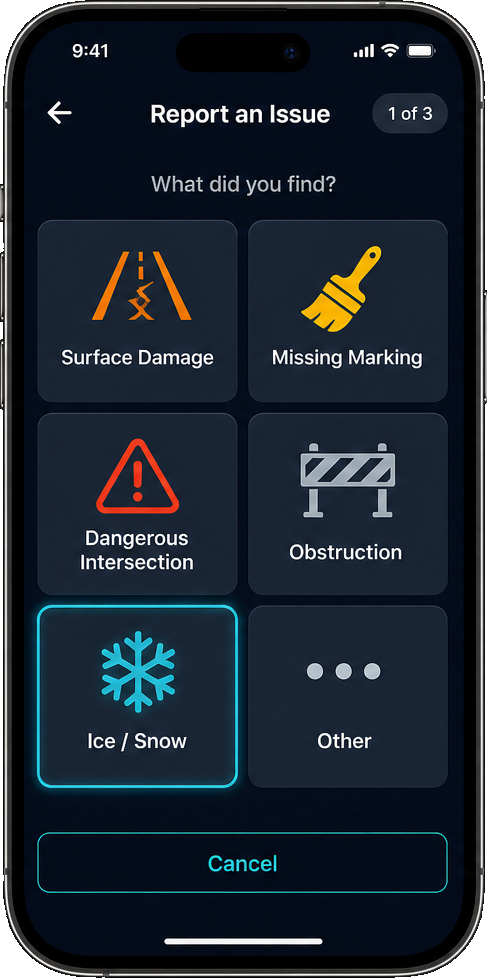
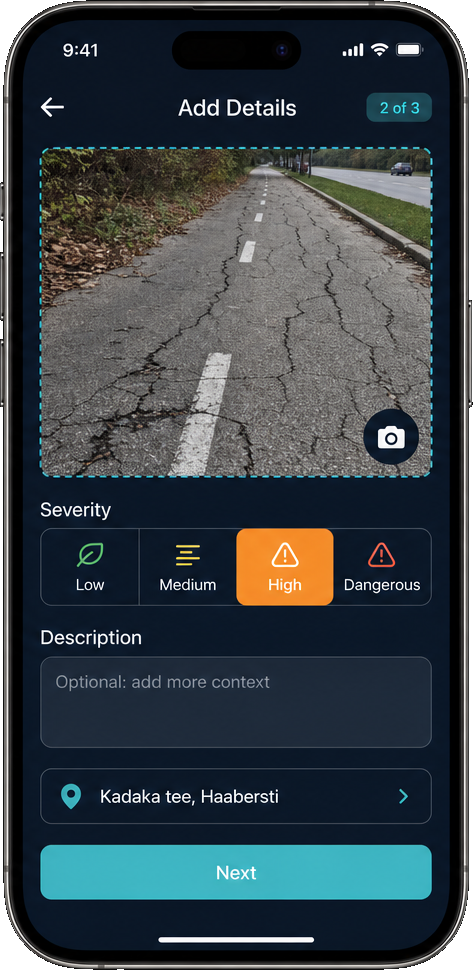
- Citizen issue reporting with map pin, severity, and optional photo evidence
- Municipality dashboard with clustering, corridor scoring, and pilot-ready workflows
- CO2 and export-ready reporting layer aligned with public-sector sustainability narratives
Pilot scope
2-3 Tallinn corridors
Focused enough for a credible MVP validation.
Reporting fit
Fast, map-based issue capture
Built around the resident experience, not a generic complaint form.
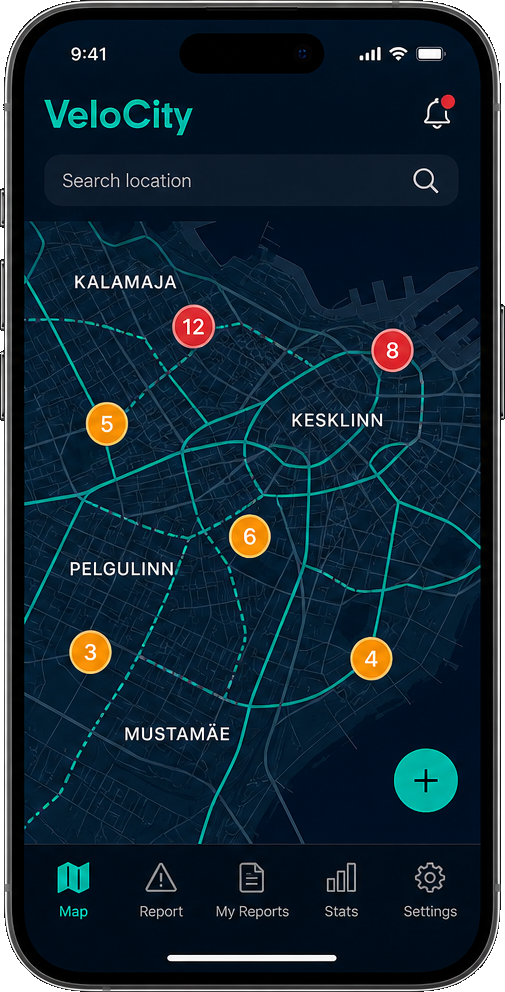
Mockups, architecture, implementation plan, and realistic MVP roadmap are in place.
The architecture is localisable and designed for Baltic municipal expansion after Tallinn.
The problem
Tallinn needs better visibility between resident reality and infrastructure investment decisions.
Cycling infrastructure is expanding, but maintenance, safety, and route quality are still hard to assess in a structured way. Today, signals are scattered across calls, email, social media, inspections, and manual planning documents.
Fragmented issue reporting
Residents can report problems, but the signal rarely turns into consistent spatial data usable for planning, prioritisation, or public accountability.
Limited corridor-level prioritisation
Planners need to defend where budget goes. Without clustering, severity weighting, and repeat-pattern visibility, decisions can look reactive instead of evidence-based.
Weak climate storytelling
Cycling supports modal shift and emissions reduction, yet most cities still struggle to communicate impact in a way that is transparent, repeatable, and usable in reporting.
The platform
Three connected modules, one operational picture.
VeloCity Tallinn is designed so the city does not need three separate tools for reporting, planning, and sustainability communication. Each module can start simple, but together they create a much stronger pilot story.
CitizenReport
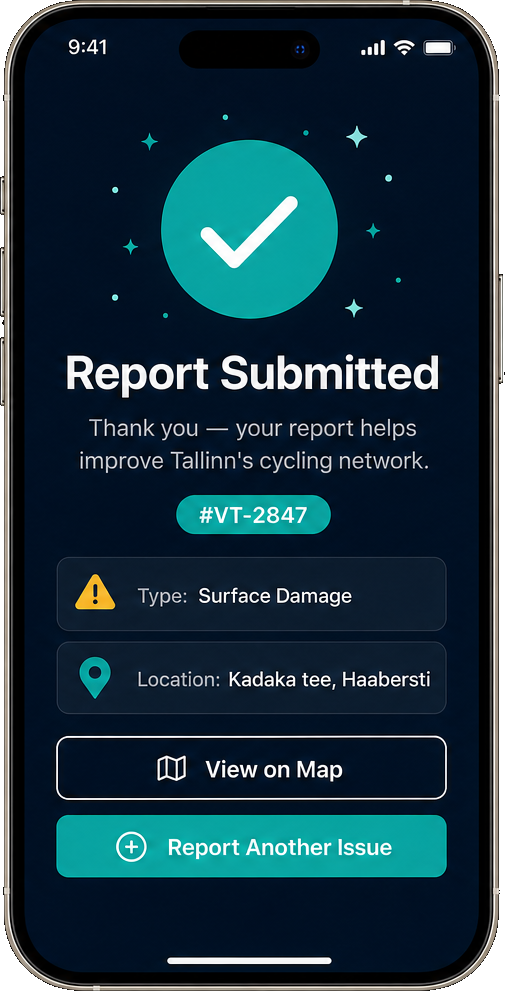
React Native app concept for iOS and Android with fast location-based issue reporting, winter categories, status updates, and public trust-building visibility.
PlannerDashboard
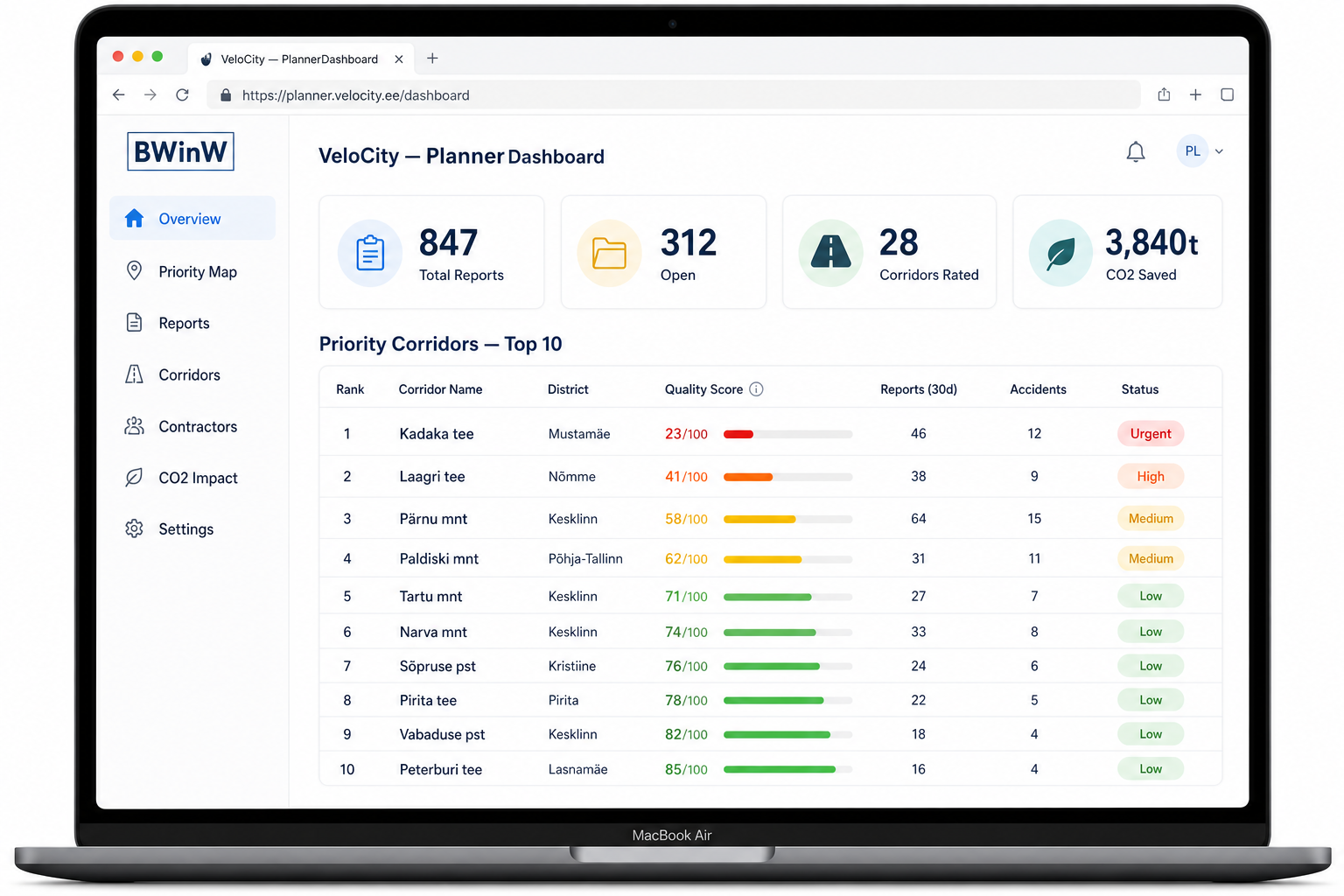
Municipality-facing web dashboard for clustering reports, ranking corridors, reviewing trends, and generating decision-ready views for maintenance and budget discussions.
ImpactTracker
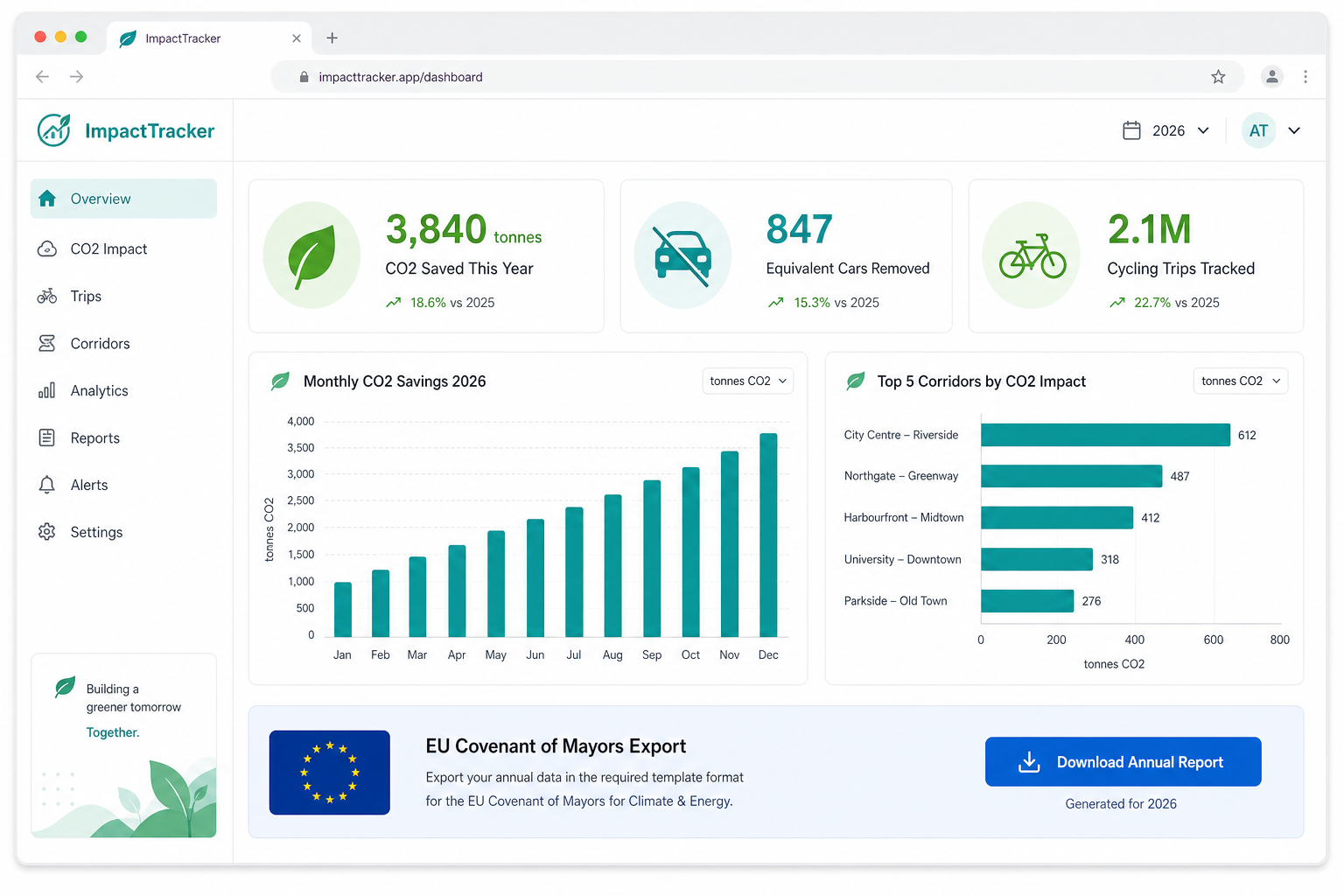
CO2 estimation and reporting layer that helps the city communicate cycling impact in a way that stays understandable, auditable, and export-friendly.
For city operations
A credible municipal workflow, not just another civic app.
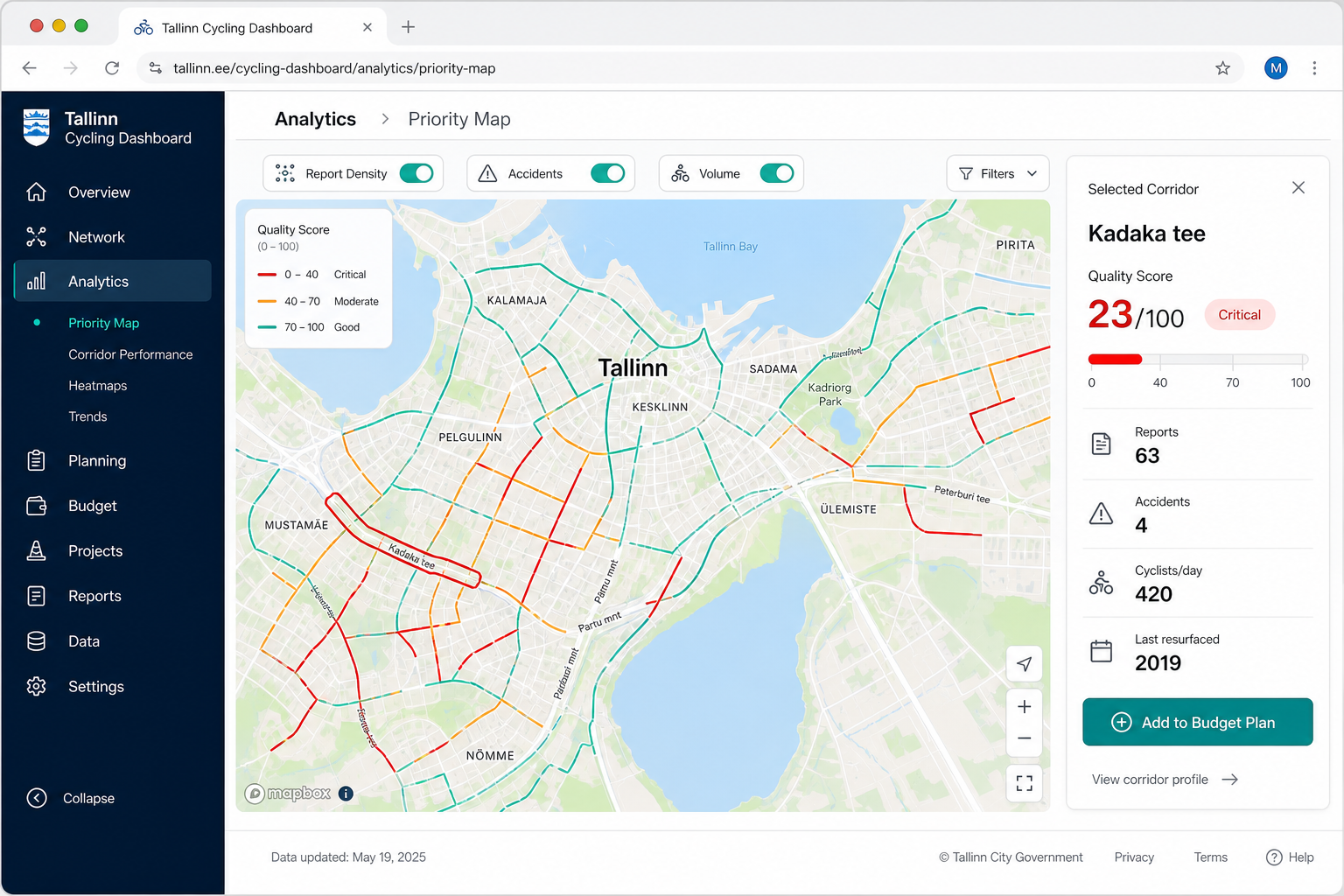
The dashboard is where the application becomes strategically interesting for Tallinn. Reports are not left as isolated tickets. They are grouped, scored, and surfaced in a way that helps planners explain why a corridor is urgent, why another can wait, and how repeated community feedback lines up with maintenance reality.
- AI-assisted clustering designed to be explainable rather than opaque
- Corridor quality scoring that can include density, severity, recency, and optional accident data
- Role-based workflow for planners, contractors, and pilot observers
- Exports for presentations, reviews, and public-sector reporting packs
For sustainability and policy
Climate impact is part of the story, but presented carefully.
VeloCity Tallinn does not pretend to deliver perfect emissions certainty. Instead, the concept positions CO2 estimation as a practical, transparent layer that helps the city communicate cycling value, pilot results, and broader sustainability relevance without overclaiming.
- Scenario-based assumptions rather than black-box metrics
- Readable annual dashboards for leadership and residents
- Export-oriented positioning for cities with similar SUMP and climate goals
- Useful bridge between mobility investment and sustainability reporting
Pilot and MVP
The funding narrative is focused: build a working MVP, then prove it on a small Tallinn pilot.
The application package positions the grant request around MVP delivery, not a fully finished production platform. That keeps the story ambitious but credible.
Architecture and design baseline
Lock UX flows, security assumptions, reporting taxonomy, and data structures for mobile, dashboard, and impact modules.
Mobile and backend MVP
Implement issue submission, map interaction, severity model, status visibility, API endpoints, and storage layer.
Planner dashboard and scoring
Launch clustered report views, corridor ranking, pilot workflows, and the first explainable prioritisation layer.
Impact layer and pilot execution
Add CO2 reporting logic, validate KPIs on 2-3 corridors, and produce a documented pilot outcome for future expansion.
Export strategy
Built for Tallinn first, but structured to travel to other Baltic municipalities.
The export plan positions Tallinn as the reference deployment, then uses configuration, localisation, and repeatable onboarding to support expansion into similar municipal contexts.
Tallinn
Anchor city and first reference case. Focus on pilot credibility, planner workflow fit, and a local smart-city narrative.
Tartu
Closest second-city expansion: similar digital patterns, strong cycling culture, and lower onboarding friction.
Riga
Higher revenue potential with more procurement complexity; suitable for a district-first or pilot-led entry.
Vilnius
Good fit for corridor prioritisation and winter-aware operations framing as cycling investment continues to grow.
What transfers well
GIS-driven corridor logic, dashboard flows, issue clustering, and reporting templates are designed to be reusable.
What needs localisation
Language, identity/access policies, GIS onboarding, and local public-sector documentation must be adapted city by city.
Why the grant story matters
A strong Tallinn MVP plus pilot evidence is the commercial proof point that makes export conversations realistic.
Product screens
Detailed visual package for the application materials.
The mockups below are concept visuals prepared for the grant package, supporting documents, and pilot conversations. They represent an early but credible alpha-stage product direction.
How the project works
From resident signal to corridor-level action in a workflow the city can actually use.
The core value of VeloCity Tallinn is not only collecting more reports. It is turning scattered feedback into a structured operational loop that helps the city detect recurring issues, justify interventions, and communicate visible progress.
Residents submit geolocated issues
People can flag potholes, unsafe crossings, missing lane markings, winter hazards, blocked routes, and other cycling-related issues directly on the map.
Reports are grouped into patterns
The platform clusters repeated submissions by location and issue type so planners can see whether a single complaint is isolated or part of a corridor-level problem.
Municipality teams prioritise corridors
Dashboard views surface severity, recency, density, and repeat frequency to support more defensible maintenance and investment decisions.
Outcomes become visible and reportable
Status updates, pilot KPIs, and climate-oriented summaries help convert raw issue data into internal planning evidence and external accountability.
Data, AI, and trust
Designed to be useful for public-sector delivery without pretending to be a black-box system.
The concept is intentionally practical. It assumes lightweight GDPR-aware data handling, clear user consent around submitted content, and explainable scoring logic that city teams can understand and defend. That makes the platform more credible for a grant-funded MVP and more realistic for municipal adoption.
- Personal data minimisation with issue-first records rather than excessive user profiling
- Explainable prioritisation logic with adjustable scoring inputs instead of opaque AI decisions
- Photo and location evidence handled as operational reporting data with role-based dashboard access
- Open-data readiness for future integration with cycling counters, incidents, and GIS layers
What the AI does
Supports clustering, duplicate detection, and initial priority suggestions to reduce manual review effort.
What people still decide
Municipal users remain responsible for intervention choices, budget allocation, and policy-level tradeoffs.
Why this matters
Public-sector tools need transparent logic, operational accountability, and audit-friendly outputs to build trust.
Submission package
The project story is already structured for grant review, pilot discussion, and MVP planning.
VeloCity Tallinn is positioned as an alpha-stage civic-tech concept with detailed product screens, a defined MVP scope, a focused Tallinn pilot narrative, and a realistic export path toward other Baltic municipalities. The public page is designed to support application reviewers and stakeholder conversations with a clearer view of what the project solves and how it would be delivered.
This public page is a concept demonstration for grant, pilot, and stakeholder discussions. It does not collect live data and should not be presented as a finished production deployment.
Application-ready package
- Detailed project document in `.docx` with embedded mockups
- Separate export and market plan in `.docx` for the Tallinn submission portal
- Website visuals, dashboard preview, and reusable product narrative blocks